Lost in the Woods, Found in a Zero-Waste Sourdough Tiny Home
When two Brooklyn tweens were sent on a mandatory 'digital detox' by their aggressively minimalist parents, they stumbled upon an artisanal trap. The real danger wasn't the lack of 5G, but a breathwork facilitator with a wood-fired oven.
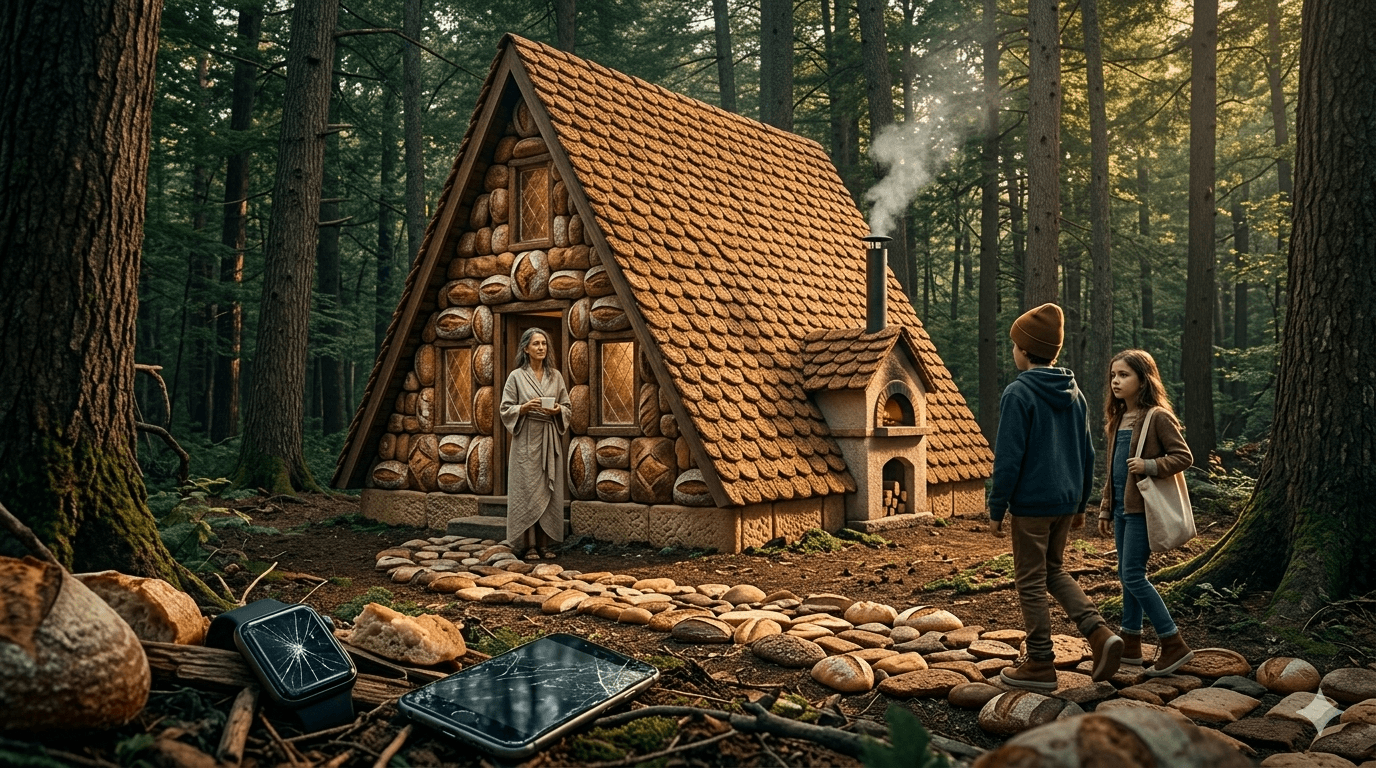
By The Styles Desk
KINGSTON, N.Y. — To understand how Hansel and Gretel found themselves held captive in a bespoke, edible architectural marvel in the deep Catskills, one must first understand their parents.
Tristan, a conceptual DJ, and Sage, an influencer specializing in “aesthetic deprivation,” had recently pivoted their parenting style to what they called Radical Un-Parenting. It was a philosophy that involved selling their Park Slope brownstone, moving into a converted Sprinter van, and systematically stripping their children of all worldly tethers, including iPads, refined sugars, and, eventually, adult supervision.
“We realized the city was over-stimulating their root chakras,” Sage explained on a recent episode of her podcast, The Empty Vessel. “We wanted them to experience the raw, unfiltered trauma of the wilderness. It builds resilience.”
And so, on a crisp Tuesday morning, twelve-year-old Hansel and his ten-year-old sister, Gretel, were instructed to go on a "spirit walk" into the densely wooded Hudson Valley. They were equipped with nothing but a canvas tote bag and half a loaf of gluten-free, ancient-grain sourdough.
Fearing they might wander too far from the van’s faint Wi-Fi signal, the children attempted to leave a trail.
“I wanted to drop AirTags,” Hansel said, adjusting his thrifted Carhartt beanie during an interview at a local matcha café. “But Dad said Bluetooth was disrupting his circadian rhythms. So we tore up the sourdough and dropped the crusts.”
Predictably, the gluten-free breadcrumbs were immediately consumed by a flock of free-roaming heritage turkeys. By nightfall, the siblings were hopelessly lost, their Apple Watches dead, their steps untracked.
It was then they stumbled upon the property.
At first glance, it looked like a standard Hudson Valley Airbnb—A-frame construction, string lights, and a composting toilet. But as they drew closer, Gretel, who has a severe allergy to processed dairy, noticed a distinct, sweet aroma.
The house was constructed entirely of artisanal, small-batch baked goods. The roof shingles were crystallized raw ginger; the windows were spun from organic agave nectar; the foundation was pure, unadulterated maca-root shortbread.
“It was profoundly off-brand for the area,” Gretel noted. “But we were starving. I took a bite out of a windowsill. It had notes of cardamom and exploitation.”
The owner of the home was Agnes, a 60-something woman who described herself as a “holistic nourishment guide” and wore a lot of raw linen. Agnes invited the freezing children inside, offering them kombucha and a place to rest by the hearth.
But the hospitality quickly revealed a sinister edge.
Agnes didn’t just want to feed the children; she wanted to optimize them. For weeks, Hansel was confined to a bamboo meditation cage, force-fed a diet of hyper-caloric bone broth, sea moss gel, and adaptogenic mushrooms. Agnes’s goal, authorities later discovered, was to fatten him up to harvest his "youthful, uncorrupted collagen" for her new line of anti-aging serums.
Gretel, meanwhile, was put to work maintaining the property's grueling aesthetic, tasked with endlessly churning almond butter by hand and sweeping the earthen floor with a bundle of ethically sourced sage.
“She kept checking Hansel’s BMI,” Gretel recalled. “Every day she’d pinch his arm. But Hansel just kept flexing his triceps and telling her he was on a cutting phase. He actually lost weight. It drove her crazy.”
The climax of their ordeal arrived when Agnes ordered Gretel to climb into the massive, wood-fired pizza oven to check if the eucalyptus logs were properly burning.
Gretel, raised by parents who outsourced everything to TaskRabbit, simply feigned weaponized incompetence.
“I told her I didn’t understand the UX design of the oven,” Gretel said with a shrug. “I asked her to demonstrate the user journey.”
Frustrated by the Gen Z apathy, Agnes leaned halfway into the oven to show her. In a swift, surprisingly athletic move, Gretel shoved the wellness guru inside and secured the heavy iron door, locking Agnes in with her own artisanal soot.
The siblings promptly looted the cottage of its high-end ceramics, grabbed Agnes’s keys to her vintage Land Rover, and drove back to civilization.
Today, Hansel and Gretel have legally emancipated themselves and are living in a heavily sanitized, Wi-Fi-optimized condo in Manhattan, funded entirely by the movie rights to their ordeal. Tristan and Sage remain in their Sprinter van, reportedly proud that their children successfully manifested their own financial independence.
Agnes survived the oven incident—thanks to its poor thermal insulation—but is currently facing multiple zoning violations for constructing a load-bearing wall out of perishable marzipan.