


The Internet Was Delicious While It Lasted
For years, the artificial intelligence industry operated on a very simple philosophy:
Take the internet.
Scrape it.
Compress it into a model.
Call it innovation.
Add a launch demo.
Raise billions.
This worked surprisingly well, mostly because the internet is enormous and humanity has spent decades filling it with books, news articles, forum posts, code, academic papers, product reviews, arguments about movies, recipes nobody reads and social media opinions produced under conditions no laboratory would ever approve.
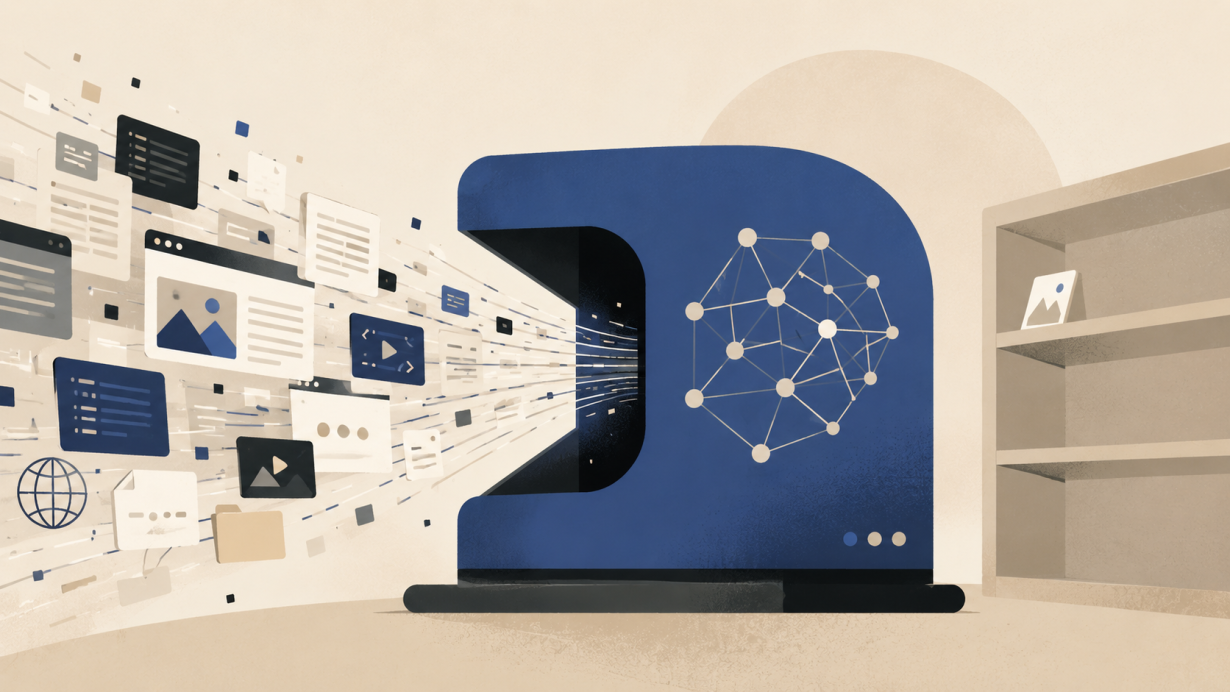
AI companies turned that giant mess into fuel. Large language models learned from human-written text at planetary scale, consuming trillions of words and becoming good enough to summarize documents, write code, produce essays, answer questions and confidently invent legal cases that never existed.
A normal industry might pause at this point and ask whether there are limits to this strategy.
The AI industry, being the AI industry, paused only after nearly eating the pantry.
Researchers have warned that the supply of publicly available, high-quality human-generated text may be exhausted within the next several years if current development patterns continue. Some estimates place the crunch somewhere between 2026 and 2032.
That does not mean every sentence on the internet will vanish into a GPU furnace. It means the clean, useful, accessible, high-quality text that can help train bigger models may stop scaling fast enough.
In other words, AI’s favorite resource is not infinite.
This has shocked the industry, which previously seemed to believe the internet was a bottomless buffet and not, in fact, a landfill with some good books buried under sponsored posts.
The Web Was Never As Clean As The Pitch Deck
The problem is not just quantity. It is quality.
The open web contains useful knowledge. It also contains spam, duplicate articles, broken pages, ads disguised as information, malware bait, conspiracy sludge, AI-generated filler and approximately 700 million pages explaining how to boil an egg.
Not all data is equal.
A medical textbook is not the same as a random comment saying lemon water cures taxes. A court filing is not the same as a Reddit thread where three users and a raccoon avatar debate macroeconomics. A carefully edited news archive is not the same as a content farm article titled “You Won’t Believe What Happens When Chair.”
For early AI models, scale mattered enormously. More data, more compute, bigger models, better results. That recipe became the industry’s comfort food.
But as models grew, the supply of easy, useful text became more valuable. The first scoop of internet data was cheap. The next scoop is harder. The cleanest material is locked behind publishers, private databases, academic access, copyright claims, paywalls and companies that have finally realized their archives are worth money.
Imagine spending years letting tech companies vacuum your house for free, then one day discovering the dust is now valued at $80 billion.
Publishers noticed.
That is why AI companies have started signing content deals with news organizations, media groups and platforms. The industry that once treated online text like public rainfall is now quietly admitting that high-quality writing has owners, prices and lawyers.
A touching moment of maturity, arriving only after the vacuum cleaner had already eaten the curtains.
The New Gold Rush Is For Human Text
AI labs are now competing for access to high-quality data. News archives, books, code repositories, scientific papers, video transcripts, legal documents and forum discussions have become strategic assets.
That sentence alone should make every writer feel both important and mildly robbed.
The irony is thick enough to qualify as infrastructure. For years, people were told that content was cheap, writing was easy, journalism was dying, forums were obsolete and human creativity could be automated.
Now the companies building the automation need the human material more than ever.
Turns out the machine still needs people. How embarrassing for the machine.
Some platforms and publishers are licensing content. Others are suing. Some are blocking crawlers. Some are negotiating. Some are doing all of the above while pretending they have a coherent long-term strategy, because nothing says “future of media” like choosing between a lawsuit and a licensing deal with the company trained on your life’s work.
The scramble reveals a basic truth: AI models are not magic brains growing in a glass box. They are built from human labor, human language and human culture at ridiculous scale.
The industry likes to call this “training data.”
A less flattering phrase would be “everybody else’s homework.”
Synthetic Data: The Snake Discovers Its Tail
If human-written data becomes harder to obtain, one tempting solution is synthetic data, meaning data generated by AI systems and then used to train other AI systems.
On paper, this sounds efficient.
In practice, it also sounds like photocopying a photocopy of a photocopy and then being surprised when the face eventually looks like a haunted potato.
Synthetic data can be useful when carefully designed, filtered and mixed with real data. AI-generated examples can help models practice certain tasks, improve reasoning patterns or fill gaps in specialized training sets.
But relying too heavily on synthetic material raises the fear of model collapse. Researchers have warned that if models are trained again and again on outputs from earlier models, quality can degrade. Rare details disappear. Diversity shrinks. Errors get recycled. The model becomes more confident and less connected to reality, which, to be fair, would make it extremely competitive in politics.
The risk is not that synthetic data is automatically useless. The risk is that companies use it as a substitute for the messy richness of human-created material.
Real human text is weird. It has surprise, contradiction, regional detail, emotion, confusion, creativity and accidental truth. It contains mistakes, but it also contains life.
Synthetic text often sounds clean, fluent and dead behind the eyes.
Basically LinkedIn.
The Internet Is Also Being Polluted By AI
There is another problem.
AI systems are now producing a growing amount of the internet they may later train on.
That means future models may scrape web pages written by older models, which were trained on human text mixed with machine text, then produce even more machine text, which gets scraped again.
A perfect loop.
Humanity built machines to learn from us, then used those machines to flood the environment they learn from.
This is the technological equivalent of teaching someone to cook, then replacing the grocery store with photographs of soup.
AI-generated slop is already filling search results, blogs, product pages, spam sites, social media and fake news operations. Some of it is harmless. Some of it is low-quality filler. Some of it is misinformation with better grammar.
For AI companies, this creates a data hygiene problem. They need fresh, reliable human material, but the web is becoming harder to classify. Is this page written by a person? A bot? A person using a bot? A bot pretending to be a person pretending not to be a bot?
At some point, “scrape the internet” stops being a strategy and becomes a contamination event.
Why This Matters For Everyone Else
This might sound like an industry problem.
It is not.
If high-quality training data becomes scarce, AI companies may push harder to access private or semi-private information. Emails, documents, workplace chats, customer service logs, educational platforms, medical records, voice recordings and user interactions could become more tempting as sources of training material.
That does not mean every company will grab everything. It means the economic pressure will grow.
Data hunger creates incentives.
And incentives are where nice privacy policies go to be quietly revised.
There is also a cultural risk. If the value of human-created work increases, creators may finally have more leverage. Publishers, artists, coders, researchers and communities can demand payment, control or exclusion.
Or, more realistically, a handful of large platforms will negotiate massive deals while individual creators receive a warm email about “ecosystem value.”
Still, the shift matters.
The AI boom has exposed how much of the digital economy depends on human work that was treated as free raw material until it became strategically valuable.
The internet was not empty land. It was people.
Messy, unpaid, badly moderated people, but people.
The Industry’s Real Problem Is Not Running Out Of Text
The deeper problem is that the old scaling story is getting harder.
For years, the AI pitch was simple: more data, more compute, bigger models, better performance. That story made investors comfortable, engineers busy and data centers extremely warm.
But if public human data stops growing fast enough, companies need other routes. Better data filtering. Better architectures. Better reasoning systems. More efficient training. More licensing. More domain-specific models. More careful synthetic data. Maybe even products that are useful without needing to ingest the entire written history of civilization every quarter.
What a concept.
The future may not belong only to the biggest model with the biggest appetite. It may belong to systems that use data more intelligently, specialize better and stop treating the open web like a free buffet run by idiots.
That would be an improvement.
It would also be less glamorous than saying your model has 10 trillion tokens and was trained in a data center that consumes enough energy to make a small nation ask awkward questions.
The Buffet Is Closing
AI companies are not out of options.
They can license content. They can improve training methods. They can use synthetic data carefully. They can develop models that need less data. They can build better evaluation systems. They can train on multimodal data, including images, audio, video and real-world interactions.
But the easy era is ending.
The internet was the first great meal. It was cheap, chaotic and massive. AI companies consumed it with the enthusiasm of a raccoon in a grocery store.
Now they are discovering that the best parts of the web have owners, limits, legal risks and quality problems.
The machines are still hungry.
The pantry is no longer pretending to be infinite.
And somewhere, a tech executive is looking at a licensing invoice and realizing that human writing may have had value after all.
Devastating.